

Of swallows and phoebes

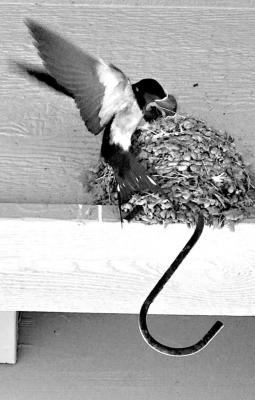
This is the time of year when I would normally write about Barn Swallows nesting since they delight me annually by raising several broods each season under the eaves of my front porch. But nesting birds close to the house present unique challenges, and not all of us deal with those the same way. This month, I’ll let good friend and Alpine resident Don Derden describe his experiences.
Having lived in an Asian country for several years, the droppings I found covering the concrete at the front door of our new house were not unfamiliar. The good luck endowed by a Barn Swallow’s residence on one’s property may work for some, but as a possible source of airborne pathogens and sundry viruses, not for me.
I decided to encourage the Barn Swallow and it’s recently fledged brood to re-home since the young were free flying, and the nest was empty. However, the birds are persistent, purpose-driven, and particularly attached to their territory.
I resorted to installing one of those steelpronged strips that prevent a bird from landing on an eave. They pursued building their nest even to the point of trying to get their little balls of mud attached to the steel prongs of the strips. Finally, they relinquished “their spot,” and moved on to a new one.
So peace and safety returned to the household until I noticed more droppings on the back porch. Not only on the porch, but the grill, the hummingbird feeders, the lawn chairs, and the tables were all liberally speckled with bird guano. As it seems to be with all times of peace and safety, it was transitory. Phase one of the conflict had ended, and phase two began.
Before re-entering the war, some diligent scouting was in order. I established an observation post on the back porch where I could read and watch when the gale force winds of West Texas permitted. It was there one sunny afternoon that the source of the guano appeared, a Say’s Phoebe. The phoebe spot had been in my field guide unmarked for years, but there she was. I cleaned off the grill cover, the hummingbird feeders, the chairs, and the tables.
I watched from inside for a while. She shifted perches frequently. Just as some dogs have an endearing way of cocking their heads, she would cock her head scanning for insects while perched atop a hummingbird feeder. A flutter of wings and a darting descent usually resulted in a quick snack.
Her defining field marks - tawny buff stomach and under tail coverts contrasting with a dark tail - were easily observed while she sat preening. Most impressive were those brilliant black eyes. I learned the birds are solitary except during mating season. They, like their cousins, become acclimated to human presence, and use buildings and other man-made structures to nest.
One afternoon on the front doorstep, bits of grass, some feathers, and soil lay on the concrete underneath the very sill adorned with the steelpronged strips. I looked up and saw a rudimentary nest, looked for mud but found none. I thought briefly about those abominable British invaders, House Sparrows, but dismissed the idea - the nest was too exposed.
A few days later I went outside late in the evening, and flushed a smallish bird from under the roof. I couldn’t see it clearly, but confirmation came a few days later when the nest was nearing completion, and the Say’s Phoebe flushed when I opened the door.
An old Nepali phrase came to mind when I confronted the fact that I had not wanted the Barn Swallows, yet was okay with the phoebe nesting in the same place. “Ke garne?” or, literally, what to do?
