

The First Lady visits Fort Davis and the Big Bend
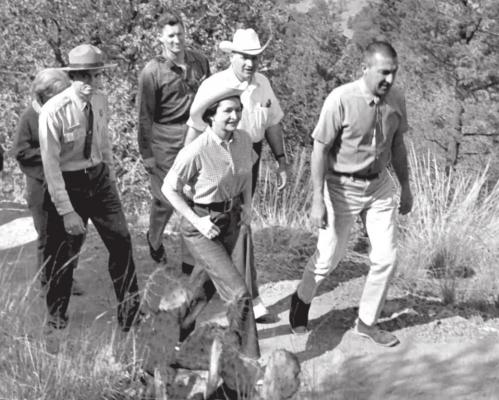
Fifty-five years ago on April 2, 1966, an American Airlines charter touched down at the Presidio County Airport. The pilot had been warned to watch for wildlife or livestock, and as he landed, antelope hurried from the scene. On board was the First Lady of the United States, Lady Bird Johnson, and Secretary of the Interior Stewart Udall on their way to Big Bend.
President Franklin Roosevelt signed Big Bend National Park into law on July 6, 1944. The creation of this park was as complex and convoluted as any activity in this country that has to do with public money and private lands. It is a story so complex that an entire book, John Jameson’s “Big Bend on the Rio Grande: Biography of a National Park” was written about the subject.
Among the activities of the First Lady was a hike up Lost Mine Trail, and a barbecue and festival at Rio Grande Village, replete with “pre-recorded coyote sounds.” She took a raft trip through Mariscal Canyon, and spent the night in one of the cabins at the Chisos Basin.
One of the national correspondents along on the trip described the 24 rafts on the trip through the canyon as “Times Square at rush hour” as they all tried to negotiate the shallow waters.
Mrs. Johnson described the Big Bend as, “wild country, completely untamed by man, but a good place to come to get your troubles in perspective,” a point as valid today as then.
By 1966, with public figures such as Mrs. Johnson and Udall and nature writers like Edward Abbey, there was a renewed interest in environmental issues. The First Lady’s trip to Big Bend was part of this movement, a new campaign promoted in part by George Hartzog, director of the National Park Service, See America First. I was a beneficiary of this program, hired as a seasonal ranger at Fort Davis National Historic Site, as the parks staffed up for a wave of new visitors.
But the First Lady’s visit to the Big Bend was not over. She had one more duty to perform. On April 4, 1966, Fort Davis National Historic Site was dedicated by Mrs. Johnson. The site was actually created on July 4, 1963. The legislation was introduced by Senator Ralph Yarborough and Congressman J.T. Rutherford and signed by President John Kennedy, but it took several years of restoration and interpretative program development.
The old fort would never have been saved had it not been for the efforts of the Fort Davis Historical Society. The Society was organized in February 1953 in the home of Malcolm “Bish” Tweedy, who lived in one of the homes on officers’ row. Leading members of the community met with the goal of saving the fort. Their first major effort was a Centennial Celebration in 1954, which attracted the interest of J.T. Rutherford, soon to be the representative to Congress from West Texas.
The dedication was held the morning of April 4, with the high school bands from Alpine, Marfa, and Marathon opening the ceremony. Park Superintendent Frank Smith, Director of the Park Service George Hartzog, Congressman Richard White, Secretary of the Interior Stewart Udall all spoke, but Mrs. Johnson dedicated the Historic Site. Records indicate that over 7,000 were in attendance, and in best West Texas fashion, the ceremony ended with a barbecue.
In the research for this column, the most difficult part was nailing down the sequence of events. Both Fort Davis Historic Site and Big Bend Park are units of the National Park Service and only 100 miles apart. However, in every public document I was able to search, neither park mentioned the fact that Lady Bird Johnson was going to visit the other. It is as if each park wanted to keep her visit for itself.
